Welcome to SPORTY GIRL BOOKS. At SPORTY GIRL, we want to give all girls the chance to love, watch, play, read, and write about any sport that interests them. We look forward to the day when the words, "You play like a girl," is the biggest compliment anyone can receive.

Thursday, July 26, 2018

#WomeninBaseballWeek Nonfiction Young Adult Books

Each day this week we will be sharing books about girls and women who play baseball. Today we are focusing on nonfiction young adult books. Books are in no particular order. The blurbs are from Amazon.

Discusses how in the 1940s and 1950s women broke traditional gender barriers by playing professional baseball.

A richly illustrated and inspiring book, Women in Sports highlights the achievements and stories of fifty notable women athletes from the 1800s to today, including trailblazers, Olympians, and record-breakers in more than forty sports. The athletes featured include well-known figures like tennis player Billie Jean King and gymnast Simone Biles, as well as lesser-known champions like Toni Stone, the first woman to play baseball in a professional men’s league, and skateboarding pioneer Patti McGee. The book also contains infographics on topics that sporty women want to know about such as muscle anatomy, a timeline ofwomen’s participation in sports, pay and media statistics for female athletes, and influential women’s teams. Women in Sports celebrates the success of the tough, bold, and fearless women who paved the way for today’s athletes.


Wednesday, July 25, 2018

#WomeninBaseballWeek Fiction Middle Grade

Each day this week we will be sharing books about girls and women who play baseball. Today we are focusing on fiction middle grade books. Books are in no particular order. The blurbs are from Amazon.

Last summer, Quinnen was the star pitcher of her baseball team, the Panthers. They were headed for the championship, and her loudest supporter at every game was her best friend and older sister, Haley. This summer, everything is different. Haley’s death, at the end of last summer, has left Quinnen and her parents reeling. Without Haley in the stands, Quinnen doesn’t want to play baseball. It seems like nothing can fill the Haley-sized hole in her world. The one glimmer of happiness comes from the Bandits, the local minor-league baseball team. For the first time, Quinnen and her family are hosting one of the players for the season. Without her sister, Quinnen’s not sure it will be any fun, but soon she befriends a few players. With their help, can she make peace with the past and return to the pitcher’s mound?

Garland, Derby, and Triple Clark spend each season traveling highways and byways in their Rambler—until summer, when small-town Ridge Creek, Virginia, calls them back. There they settle in, selling burgers and fries out of Garland’s Grill after each game the Rockskippers play in their battered minor-league baseball stadium. Derby’s summer traditions bring her closer than she’s ever been to a real home that isn’t on wheels, but this time, her return to Ridge Creek reveals unwelcome news. Now the person Derby loves most in town needs her help—and yet finding a way to do so may uncover deeply held stories and secrets.

For an eighth grader, Molly Williams has more than her fair share of problems. Her father has just died in a car accident, and her mother has become a withdrawn, quiet version of herself. Molly doesn’t want to be seen as “Miss Difficulty Overcome”; she wants to make herself known to the kids at school for something other than her father’s death. So she decides to join the baseball team. The boys’ baseball team. Her father taught her how to throw a knuckleball, and Molly hopes it’s enough to impress her coaches as well as her new teammates.

Smarty Marty, and her little brother Mikey, are back in the first in a series of illustrated chapter books, about a girl who loves baseball, written by San Francisco Giants in-game reporter Amy Gutierrez. Smarty Marty is the official scorekeeper for her little brothers Little League team. But when the game announcer fails to show up for the first game, Marty is called to announce the game, inspiring her dream not only to score but to announce. But not everyone is happy about a girl getting to announce a baseball game.

Madison is not your average 12-year-old girl from Michigan in 1980. She doesn’t use lipgloss, but she loves to play sports, and joins baseball for the summer—the first girl in Southern Michigan to play on a boys’ team. The press call her a star and a trailblazer, but Madison just wants to play ball. Who knew it would be so much pressure? Crowds flock to the games. Her team will win the championship—if she can keep up her pitching streak. Meanwhile, she’s got a crush on a fellow player, her best friend abandons her for the popular girls, the “O” on her Hinton’s uniform forms a bulls-eye over her left breast, and the boy she punched on the last day of school plans to bean her in the championship game.

Every boy in the neighborhood knows Katy Gordon is their best pitcher, even though she's a girl. But when she tries out for Little League, it's a whole different story. Girls are not eligible, period. It is a boy's game and always has been. It's not fair, and Katy's going to fight back. Inspired by what she's learning about civil rights in school, she sets out to prove that she's not the only girl who plays baseball. With the help of friendly librarians and some tenacious research skills, Katy discovers the forgotten history of female ball players. Why does no one know about them? Where are they now? And how can one ten-year-old change people’s minds about what girls can do? 

When 13-year-old Joelle, a star baseball player, moves to a new town where the only option for girls is softball, she starts an all-girl baseball league against the wishes of her school coaches and others in the town.

Allie loves baseball. It's the one thing that has been consistent in her lately complicated life. Allie's father left recently, and now Allie has a new family—her mother's new girlfriend, Phyllis, and Phyllis's son, Miles, have moved in. It's taking some adjustment, mostly because Miles seems determined to get under her skin. Things start looking up when Allie gets invited to join the boys' baseball team as their new pitcher. But then Miles announces that he's quitting the boys' team and trying out for Allie's old team—a girls' team!

Fran Cullers is having a horrible summer. She was a star player on the Little League team in her old town, so the Highwater Hardwares should be thrilled to have her-except that they hate girls. She can run rings around these guys, but they won't even give her a chance. So Fran sets out to destroy the Hardwares. But vengeance is a dangerous thing, as she soon finds out. Fran, who has already faced some terrible losses, is about to lose the most important thing in her life-unless her family and friends come to her aid when she needs them most.

Named after the mighty Babe Ruth, Ruth DiMarco has some big shoes to fill. But she’s already on her way to achieving her dream of becoming a major-league baseball player. Eleven-year-old Ruth is the star shortstop in her small Maine town, and now a reporter is coming to interview her for Sports Illustrated magazine. She’s at the top of her game. Then she overhears her father in the crowd: “Real major-league talent. But I can’t help thinking what a shame it is that it’s all wasted on a girl.” 

This last book was written by our sporty girl blogger, Stacy Mozer. When thirteen-year-old Sam Barrette’s baseball coach tells her that her attitude's holding her back, she wants to hit him in the head with a line drive. Why shouldn’t she have an attitude? As the only girl playing in the 13U league, she’s had to listen to boys and people in the stands screaming things like “Go play softball,” all season, just because she’s a girl. Her coach barely lets her play, even though she’s one of the best hitters on the team. All stakes now rest on Sam’s performance at baseball training camp. 


Tuesday, July 24, 2018

#WomenInBaseballWeek Nonfiction Middle Grade

Each day this week we will be sharing books about girls and women who play baseball. Today we are focusing on nonfiction middle grade books. Blurbs are from Amazon.

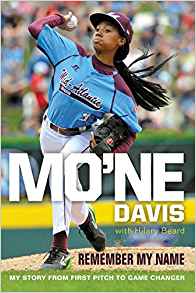
At the age of thirteen, Mo'ne Davis became the first female pitcher to win a game in the Little League World Series and the first Little Leaguer to be featured on the cover of Sports Illustrated. A month later she earned a place in the National Baseball Hall of Fame. This inspiring memoir from a girl who learned to play baseball with the boys and rose to national stardom before beginning eighth grade will encourage young readers to reach for their dreams no matter the odds. Mo'ne's story is one of determination, hard work, and an incredible fastball.
For 12 seasons, from 1943 to 1954, the All-American Girls Professional Baseball League captured America's attention with top-notch playing, and showed everyone that a woman's place was at home only when she was at bat, behind the plate, or scoring a run!

Motivated by her love for the game and inspired by the legendary Jackie Robinson, Mamie Johnson is determined to be a professional baseball pitcher.  But in a sport that's determined by white men, there is no place for a black woman.  Mamie doesn't give up-from the time she insists on trying out for the all-male, all-white Police Athletic League until she realizes her dream and becomes one of three women to play in the Negro Leagues.  Mamie Johnson's life shows that with courage and perseverance one can overcome even the greatest challenges.


Monday, July 23, 2018

#WomeninBaseballWeek Fiction Picture Books

Each day this week we will be sharing books about girls and women who play baseball. Today we are focusing on fiction picture books. Blurbs are from Amazon.

Amy's dad is away, fighting in World War II, and her mama must take a job. But it's no ordinary job--Amy's mother becomes a baseball player in the first professional women's league! Amy cheers louder than anyone at all of the home games. And while Mama's team travels, Amy works on a secret project--a surprise for her dad when he is finally back home. Historical Fiction.

A young girl's grandmother tells her of her love for baseball growing up in the 1940s and the day they let her play in the game even though she was a girl.

Elly has everything a girl could desire: bonbons, pretty clothes, maids to put everything in order, and a family that treats her like a princess. Except that, to her, life’s a boring, royal pain. All Elly really wants is to be with other kids—especially when they play baseball. She dreams of opening days, double plays, and joining the team. Then, one day, her fairy godfather arrives to make her wish come true. 


Sunday, July 22, 2018

#WomeninBaseballWeek Nonfiction Picture Books

Each day this week we will be sharing books about girls and women who play baseball. Today we are focusing on nonfiction picture books. Blurbs are from Amazon.

 
The true story of Marcenia Lyle, an African American girl who grew up to become "Toni Stone," the first woman to play for a professional baseball team. 

When Alta Weiss throws a corncob at a tomcat chasing her favorite hen, folks know one thing for sure: she may be a girl, but she's got some arm. At the age of six Alta can nail any target, and by seventeen she's outpitched every boy in town. Then one day her father takes Alta to Vermilion, Ohio -- home of the semipro baseball team called the Independents. "Where do I sign up?" she asks. But one look at Alta tells the coach all he needs to know: She's a girl, and girls can't play baseball. But faster than you can say "strike out," Alta proves him wrong: Girls can play baseball!

Did you know that one of America's favorite songs, "Take Me Out to the Ball Game," was written about a girl? And that in the 1940s girls all across America were crazy for our country's favorite game?
These little known facts inspired Shana Corey to imagine a story about how one determined girl made her way to the big leagues & found a sisterhood of players in pigtails. With the same exuberant spirit that fueled the formation of the All American Girls Professional Baseball League, joyful text & jubilant pictures celebrate these brave girls' love of the game & the league they called their own.

Ten-year-old Dandi (affectionately called "Dan" by family and friends) lives and breathes baseball. She may not be a fence buster but she can "hit 'em where they ain't" in the neighborhood pick-up games. The boys know she's a contender. And there's no bigger fan of the 1961 Kansas City A's. So when Charlie Finley, the A's new owner, announces an essay contest to get batboys, there's no doubt Dandi will enter the contest. Dandi not only enters the contest--her essay wins! However, her joy is short-lived when the contest officials enforce the For Boys Only rule. Long before the boundary-breaking ruling of Title IX, young women across the country used grit and determination to prove that barriers of gender have no place on a level playing field.

Beginning in 1922, when Edith Houghton was only ten years old, she tried out for a women’s professional baseball team, the Philadelphia Bobbies. Though she was the smallest on the field, soon reporters were talking about “The Kid” and her incredible skill, and crowds were packing the stands to see her play. Her story reminds us that baseball has never been about just men and boys. Baseball is also about talented girls willing to work hard to play any way they can.


Effa always loved baseball. As a young woman, she would go to Yankee Stadium just to see Babe Ruth’s mighty swing. But she never dreamed she would someday own a baseball team. Or be the first—and only—woman ever inducted into the Baseball Hall of Fame. From her childhood in Philadelphia to her groundbreaking role as business manager and owner of the Newark Eagles, Effa Manley always fought for what was right. And she always swung for the fences.


Sunday, July 15, 2018

#WomeninBaseballWeek July 22 - 28, 2018

Next week is Women in Baseball Week. To help celebrate, Sporty Girl Books will be sharing kidlit books about girl and women who play baseball.

Here's our schedule:

July 22: Nonfiction Picture Books
July 23: Fiction Picture Books
July 24: Nonfiction Middle Grade
July 25: Fiction Middle Grade
July 26: Nonfiction Young Adult
July 27: Fiction Young Adult
July 28: Books Releasing Summer 2018 and Beyond

We hope you will join us in celebrating these books, adding them to your list, sharing them with kids, and letting us know about any we forget. 

For more about Women in Baseball Week, see the flyer below.

Tuesday, June 5, 2018

Interview with author of Tiny Infinities, J.H. Diehl

I really enjoyed reading TINY INFINITIES by J.H. Diehl. Today I am delighted to introduce you to her and her book. J.H. Diehl spent a dozen years as a summer swim team mom and more years cheering from the pool deck at high school swim meets. TINY INFINTIES (Chronicle, May 2018), is her debut MG novel about a swimmer. It is a Fall 2018 Junior Library Guild Selection. J.H. has an MFA from the Iowa Writers' Workshop, and her short fiction received a Maryland Individual Artist Award and a Michener-Copernicus Fellowship. 

One of the driving forces in your main character Alice is her love of swimming. Why did you decide to make her a swimmer? Did you swim competitively when you were Alice’s age?
The idea for TINY INFINITIES came from a picture of a fantastical firefly that my daughter drew in third grade. The moment I saw it, an image entered my head of an older girl standing by a younger girl in the dark, with their hands cupped around glowing fireflies. The younger girl was saying the word ‘bugfire’ – the first word she’d spoken in years. When I unspooled a story from this scene, I knew it had to take place during the summer, because the season for fireflies is summer. 

I wanted the older girl - my main character, whom I named Alice - to have a summer activity and a place to go outside her home. I wanted her also to be passionate about a goal besides her goal to reunite her family. My kids swam on a summer team for more than a decade. I knew a summer swim team would be perfect for Alice. So you could say I came to swimming in a roundabout way. That is, I didn’t set out at first to write about a competitive swimmer. But as soon as I started, swimming, as you say, quickly became a driving force in the book. Alice’s team, her practice schedule, and the sport itself soon became vital and organic to the story. The Cherrywood Sharks’ competition schedule provided a framework on which to hang a number of important plot twists. The pool became the setting for a number of important scenes. And for me, Alice’s story became one that is partly about how a sport can help a kid through tough times.

I didn’t grow up swimming competitively – but I did marry into a swimming family. In fact, I’m the only person in two generations who did not swim competitively at some point. However, my dozen years as a summer swim team parent provided plenty of inspiration. And I had lots of in-house expertise to consult, whenever I needed it.

Some of the many things I love about summer swim teams are – I’m guessing – translatable to many other sports. There are opportunities to experience success and failure. There is almost always a way to find something positive in your own personal swim times. Likewise, there is almost always somebody who’s faster than you are, unless you are Katie Ledecky – who in fact grew up swimming in the summer league that I used as a model in this book.

Like my character Alice, you are part of team, and competing against other swimmers, but really you’re competing against yourself, and trying to improve. Swim team also gives kids great opportunities to build physical and emotional strength, and leadership skills. And there are opportunities for friendships with peers that kids might not have gravitated to otherwise. This is true for Alice, who makes friends with a new member of the team, Harriet, who’s just moved to town and happens to be the same age. It’s thanks to their swim team that these two unlikely friends forge a bond that, in the end, helps each one, in very different ways, to do some growing up.

I really liked Alice’s swim coach, Coach B. She was so supportive and she seemed to know Alice better than most of the adults in her life. Did you model her on anyone?
In the universe of most middle grade novels, the main character has parents or another adult relative who provides a safe, secure haven for a young person who’s out in the world facing a challenge. In TINY INFINITIES, I was interested in characterizing a version of what it’s like to grow up without that emotional safe haven. A few secondary adult characters are – to an extent – supports for Alice, and Coach B (for Bowling) is one of them. She isn’t modeled on any one person. For me, she represents all those wise teachers and mentors you hope each child’s life will intersect with. People who aren’t related, but who can see a lot of what’s going on with a young person – and whose job it is to motivate and encourage. I borrowed Coach B’s name from a beloved former music teacher at a local elementary school, and her love of corny puns echoes my late dad (I’ve been told I inherited this corny streak…).

The title of your book is Tiny Infinites. Can you tell us more about that idea and how it became part of the book? 
The title comes from a conversation between Alice and Harriet early in the story. They’re in the pool snack bar, after swim practice one afternoon, when Harriet talks about her birthday, which is Pi Day, and the number pi. She marvels that the difference between an infinite number like pi, and the number it gets rounded off to in many math problems – 3.14 – is so tiny: “Shouldn’t there be a huge difference between infinity and any number that has a definite end? Isn’t it interesting that the real difference between an infinite number like pi and a finite one like three point one four turns out to be a very tiny decimal? An infinitesimal decimal, to be as exact as possible about that inexactness?”

Then she and Alice discuss whether or not there’s a big difference between hot and cold – or is that a teeny tiny infinity, too? Alice translates this idea to her family, and wonders about “the point at which my parents had gone from loving each other to not loving – was that a teeny tiny change, too? What had made the difference between them deciding we could all be a family of five, and my dad living someplace else?” 

Also, as Alice’s summer unfolds, she spends a lot of time parsing the difference between lying to the adults in her life and not lying. Especially when she attempts to prove that she really was telling the truth when she heard a word spoken by her four-year-old neighbor, whom everybody else believes to be mute.

Part of Alice’s growing up in the book has to do with deciding where boundaries lie; and in knowing when she has to draw them in herself.

What was your journey to publication? 
Before TINY INFINITIES, I published two picture books and wrote leveled readers for educational publishers; I’ve also published fiction for grown-up audiences in journals and magazines and worked as a newspaper reporter. The journey for Tiny Infinitieswas long and windy, because I had other projects along the way. But, ultimately, it’s been an extremely satisfying one, in large part due to Chronicle Books, a great home for me and this novel, and my wonderful editor there, Taylor Norman. 

Do you have any advice for someone writing a sporty girl book?
Focus on your character(s) specific experiences of the sport, or sports, in your book; find a way to make the sport itself organic to both the action and themes of your story. In other words, try to integrate the sport – how it’s played, its rules, regulations, necessary equipment – with the plot’s twists and turns, your character’s goals, the themes you’re exploring and the questions the book raises. However, even if you’re writing from inside the sport, with expert knowledge, find ways to characterize it that a reader unfamiliar with the sport can relate to. Creative similes and descriptive verbs can help. Be careful to strike a balance between creating believability - through the use of idioms and terminology specific to that sport - with the need to reach out to readers who aren’t familiar it. This can help you to connect the specifics of the action to the more universal conflicts and themes of your story. 


Want to know more about J.H. Diehl? You visit her website: https://www.jhdiehl.com/, follow her on Twitter and Instagram at @jhdiehl and on Facebook at @jhdiehlbooks.

And don’t forget to check out TINY INFINITIES


From Indiebound: When Alice's dad moves out, leaving her with her troubled mother, she does the only thing that feels right: she retreats to her family's old Renaissance tent in the backyard, determined to live there until her dad comes home. In an attempt to keep at least one part of her summer from changing, Alice focuses on her quest to swim freestyle fast enough to get on her swim team's record board. But summers contain multitudes, and soon Alice meets an odd new friend, Harriet, whose obsession with the school's science fair is equal only to her conviction that Alice's best stroke is backstroke, not freestyle. Most unexpected of all is an unusual babysitting charge, Piper, who is mute--until Alice hears her speak. A funny and honest middle-grade novel, this sharply observed depiction of family, friendship, and Alice's determination to prove herself--as a babysitter, as a friend, as a daughter, as a person--rings loud and true.