
For anyone who loves to watch, play, read, and write about girls in sports.
Showing posts with label Anna E. Jordan. Show all posts
Showing posts with label Anna E. Jordan. Show all posts
Thursday, June 9, 2016
Sporty Girl Book Review: The Flip Side by Shawn Johnson
Thanks to NetGalley for the eGalley of THE FLIP SIDE.
In THE FLIP SIDE by Shawn Johnson, main character Charlie Ryland's Olympic gymnastic dreams are clear but Charlotte Ryland, Charlie's public school persona isn't quite as sure. After all, public school comes with grades, student government, boys, and prom--all of which are distractions as Charlie approaches her Olympic qualifying competition.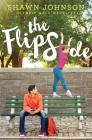
And there's that other small issue--no one at school has figured out that Charlotte and Charlie are the same person. It's this secret that builds tension through the novel and keeps the reader wondering. What will happen when her best friend Zoe, and the other students finds out about Charlotte's secret double life?
Shawn Johnson, with A.L. Sonnichsen, give us a wonderful inside view of how athletes struggle to separate the public and private parts of their life. If you look at Shawn Johnson's YouTube channel or other social media, it seems that there is little divide. However, this books reminds us that we never really know the people we see on TV. Celebrity necessitates dual personalities in order to stay sane, or in order to "embrace the crazy," as Charlie says in the book. It is during these inside peeks at the challenges elite athletics face that the reader hears Charlie's most authentic voice. We get to witness how many sacrifices young athletes make to compete at the Olympic level and how when things get difficult, it's fellow athletes they turn to for support. "If you can't fall apart with us," Gwen (her gymnastics best friend) says, "where can you fall apart?" (p. 252)
There were a few times when I was pulled from the story by a voice that felt too adult for Charlie. During those lapses, I could make a case that she had to grow up quickly and had media training, but I didn't think that the formal construction of some of her speech with friends or with other adults was authentic.
I also wondered how it was that her school best friend, Zoe, never ever went to her house and saw the walls of medals and gymnastics pictures. Even the authors riff that her dual identity disguise, glasses and a different hair style, was lame in a Clark Kent/Superman way.
Still, the depiction of a close-knit family that supports Charlie's lofty goals and makes sacrifices right along with her seemed spot on.
Still, the depiction of a close-knit family that supports Charlie's lofty goals and makes sacrifices right along with her seemed spot on.
While I had a few craft concerns, the book kept me turning pages. Like an NBC Olympics human interest story, THE FLIP SIDE has the athlete-overcoming-adversity plot line that a reader can count on.
For other great gymnastics titles, see yesterday's post Happy Book Birthday's: June is Coming Up Gymnastics.
For other great gymnastics titles, see yesterday's post Happy Book Birthday's: June is Coming Up Gymnastics.
Tuesday, June 7, 2016
Happy Book Birthdays! June is coming up Gymnastics.
There's a weird sort of hive mind in the world of publishing and today's post is evidence. Three great books about gymnastics are having their book birthdays today. So if you are a reader who dreams about round-off back handsprings or if you regularly land on a balance beam that is four inches wide today is your day too.
Happy #bookbirthday to Karlin Gray author of NADIA: THE GIRL WHO COULDN'T SIT STILL (Houghton Mifflin Harcourt).
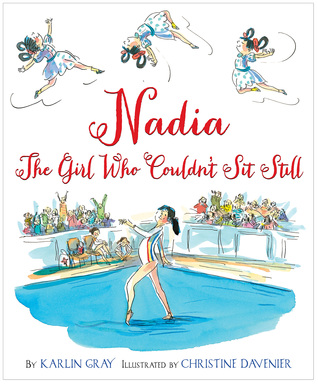
Nadia Comaneci was a feisty and fearless little girl who went from climbing trees in the forests of Romania to swinging into history at the 1976 Olympic Games, where she received an unprecedented seven perfect scores in gymnastics. But as readers will see in this first-ever illustrated picture book about Nadia’s journey to Olympic gold, the road from small-town girl to world-class athlete was full of many imperfect moments. Expert illustrations that capture the energy and fluidity of Nadia's exuberant gymnastic routines and referential back matter round out this inspirational story of determination and overcoming adversity. A perfect 10.
Happy #bookbirthday to Caela Carter author of TUMBLING (Viking Books for Young Readers).
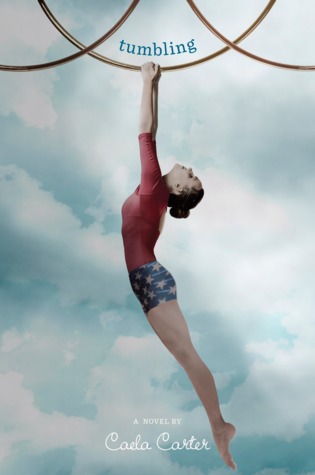
Grace lives and breathes gymnastics—but no matter how hard she pushes herself, she can never be perfect enough.
Leigh, Grace’s best friend, has it all: a gymnastics career, a normal high-school life…and a secret that could ruin everything.
Camille wants to please her mom, wants to please her boyfriend, and most of all, wants to walk away.
Wilhelmina was denied her Olympic dream four years ago, and she won’t let anything stop her again. No matter what.
Monica is terrified. Nobody believes in her—and why should they?
By the end of the two days of the U.S. Olympic Gymnastics Trials, some of these girls will be stars. Some will be going home with nothing. And all will have their lives changed forever.
Happy #bookbirthday to Shawn Johnson and A.L. Sonnichsen authors of THE FLIP SIDE (Simon & Schuster Books for Young Readers).

From gold medalist and reality TV star Shawn Johnson comes a debut YA novel inspired by her own experiences as an elite teenage gymnast—just in time for the Summer 2016 Olympic games.
Charlie Ryland has a secret.A longer review will follow this week!
She may seem like your average high school sophomore—but she’s just really good at pretending.
Because outside of school Charlie spends all her waking hours training to become one of the best gymnasts in the world. And it’s not easy flying under the radar when you’re aiming for Olympic gold…especially when an irresistible guy comes along and threatens to throw your whole world off balance.
Inspired by her own experiences as a fifteen-year-old Olympic gymnast, gold medalist Shawn Johnson writes a delightfully entertaining novel about chasing big dreams and falling in love, all while trying to keep it real.
As we journey on the Road to Rio this year, I predict that you'll see a lot more books with female athletes. Let's hope that publishers go beyond the well-known sports of soccer, swimming, and gymnastics. I'd love to see a rowing book (ahem, wish it were mine), fencing, or canoeing (see other little known Olympic sports here.)
Tuesday, May 17, 2016
Sporty Book Birthday! GIRL AGAINST THE UNIVERSE by Paula Stokes
Today is the book birthday for GIRL AGAINST THE UNIVERSE, the
wonderful new young adult novel by Paula Stokes from Harper Teen. (Advanced Reader Copy provided by the author.) It’s never too late to catch up on your
Paula Stokes reading. We have an interview with
her about her 2014 release THE ART OF LAINEY or you can check out Paula’s Facebook, Twitter
or Website.
Shop Indie Bookstores
So why do I say this book is wonderful? It’s layered. With GIRL AGAINST THE UNIVERSE, Paula Stokes gives us a sporty girl book featuring tennis, a romance based on friendship, and a deeply serious look at mental illness.
Maguire has been through a lot in her young life. In her
early teens her father, uncle and brother were killed in a car accident while
she walked away without a scratch. Later, a roller coaster careened off the
tracks and again she was fine in the midst of suffering. But when her candle
set the neighbor’s home on fire things became all to clear for Maguire. She was
bad luck, cursed. Her very presence was sure to injure others. At least that’s
what she believes. In order to control her world she does safety checks, avoids
public transportation, won’t drive with others and hides away from others. It’s
not until she meets a wonderful behavioral therapist that things start to
change for her.
Maguire’s concrete desire drives the plot and keeps the
reader squarely in Maguire’s court. “I want to see where my dad grew up, see my
grandma again, meet all my relatives” (Stokes, 28.) The problem? Grandma is in
Ireland and Maguire is sure if she’s on that plane, it’ll go down and no one
will survive. The reader realizes that the task is large but she is rooting for
Maguire every step of the way.
The reader isn’t the only one rooting for Maguire. Stokes has
surrounded Maguire with other characters who challenge and support her. The
romantic lead is tennis star, Jordy who also sees Dr. Leeds. The friendship
between Maguire and Jordy grows believably over time and while there are plenty
of references to Jordy’s hotness, I was pleased to see that Stokes allows these
teens with issues to take it slowly—and uses humor to build their relationship.
Maguire and Jordy have an easy banter that doesn’t feel forced or overly
scripted.
The other thing that evolves slowly is Maguire and Jordy’s
individual mental health treatment successes. There are no silver bullets when it comes to
dealing with mental health issues and early on in the book, when Maguire is
ready to be "fixed," Dr. Leeds explains that that isn’t how therapy works.
“You’re not a toaster, Maguire. You’re not here to be
fixed…The first thing you need to realize is that mental health is fluid. It’s
not like you have an infection and a doctor gives you antibiotics and then
you’re cured. No matter what the two of us accomplish together, you’re still
going to have good days and bad days…”(Stokes, 27.)
Maguire’s good days come through hard work. She creates a
series of goals to work through her PTSD and OCD issues. The goals are
presented in a list-form that is seamlessly integrated so it doesn’t stop the
flow of the story. (Way to go designers!)
I did have a few concerns: the friends in her new high
school sometimes feel like they stepped off a teen movie set, and there was one
point when I jotted down that a scene could have been slowed down to unpack the
emotional impact for Maguire.
The most important note I made was, “I don’t want to stop
reading!” and if you’re anything like me—GIRL AGAINST THE UNIVERSE, will be on
your shelf of sporty girl favorites.
Reading fiction heightens your awareness and is a catalyst
for connections. At the same time I read GIRL AGAINST THE
UNIVERSE (April 2016), the magazine Women’s Health published a fabulous article, “Which
One of these Women Has Mental Illness,” about the stigmas and realities of
living with mental illnesses and the National Center for Health Statistics
released their
report on suicide. Suicide
rates in this country have consistently and constantly increased. A slow
rising line that symbolizes the mountain that seems insurmountable for so many who take
their own lives. If you are living with any type of mental illness including
anxiety, or depression, or if you know someone who is, please get help.
National Suicide Prevention Lifeline – 1‑800‑273‑TALK (8255)
SAMHSA Treatment Referral Helpline –1‑877‑SAMHSA7 (1‑877‑726‑4727)
Would you like the review copy ARC and book mark both signed by the author? List one of your goals in the comments!
a Rafflecopter giveaway
a Rafflecopter giveaway
Tuesday, April 5, 2016
Sporty Girl Books Needs Your Coaching!
Spring has sprung in most of the country (even though it feels like 18º here in Maine) and teams are practicing outdoors and in gyms for a season of new competition. Here at Sporty Girl Books we are in training too: reading great books to review, interviewing authors and industry professionals, and keeping up with issues in the union between women and sports*.
Good training often requires coaching and we'd love your coaching now.

If you read Sporty Girl Books, please follow us to get our posts delivered to your email, friend us on Facebook, and follow us on Twitter. We always appreciate your comments and hope that you'll comment as our coaches today and everyday.
*In fact, right now the US Women's National Soccer Team have filed a wage-discrimination action against the U.S. Soccer Federation with the Equal Employment Opportunity Commission. More as it becomes available.
Good training often requires coaching and we'd love your coaching now.

- What books would you like us to review?
- What authors or athletes would you like to know more about?
- What questions about publishing we could answer?
- If you are an author, let us know. Take a look at our review policy. We'd love to be a part of your blog tour.
- We also love guest bloggers and would love your sporty girl book pitch for a relevant article.
If you read Sporty Girl Books, please follow us to get our posts delivered to your email, friend us on Facebook, and follow us on Twitter. We always appreciate your comments and hope that you'll comment as our coaches today and everyday.
*In fact, right now the US Women's National Soccer Team have filed a wage-discrimination action against the U.S. Soccer Federation with the Equal Employment Opportunity Commission. More as it becomes available.
Sunday, March 27, 2016
Retro Review: The Running Dream by Wedelin Van Draanen
My sophomore year of high school, (the first year of high school as I had gone to a 7-9 middle school), I joined the rowing team. It was all land work outs all the time. Running, circuits, and rowing machines brought me closer to spring break when we'd first get on the water. The day we were let out for break, I was so excited that I hopped down the last five stairs in school and did something to my leg. Later that afternoon I found out I'd fractured my ankle. I wouldn't row that year at all. It was a palpable sense of loss but not near as great as Jessica's loss in the 2012 Schneider Award Winning book, THE RUNNING DREAM by Wendelin Van Draanen.

A school bus accident leaves sixteen-year old runner, Jessica a below the knee amputee with running little more than a reoccurring dream. But dream she does. Jessica is young and she has the drive of an athlete plus the support of family and friends. She heals quickly and learns to walk to again. Along her journey, her goals shift and change and the obstacles are many--a math teacher who won't give an inch, financial and legal issues, other runners who see her as distraction and a huge lack of self-esteem that is constantly challenged by the pipe she now has for a leg. "It's distrubing how fast weeds take root in my garden of worthiness. They're so hard to pull. And grow back so easily" (312).
The book is structured in five parts: Finish Line, Headwind, Straightaway, Adjusting the Blocks, Starting Line that chronicle Jessica's journey. Van Draanen's love for running is apparent and the reader is drawn in not only by the Jessica's love for the sport but for her loss and longing. The medical aspects of Jessica's amputation, her recovery, and prosthetic appointments are vivid and engaging. The reader feels as if she's in capable and trustworthy hands without having the text read like a medical journal.
After her absence, Jessica is saddled with a huge homework load which introduces the reader to Rosa, a math whiz with Cerebral Palsy who has a wheelchair. Throughout the story, Rosa's more existential and philosophical view of life gets Jessica and the reader thinking. Who is visible and invisible in our world? How can people be convinced to see the person behind the condition or disability? Where are the starting and finish lines in our life and how does one lead to another?
Cerebral Palsy Day is celebrated in the US on March 25th (two days ago) but World CP Day takes place the first Wednesday in October. This year (2016) that's Wednesday, October 5th.
This book was the 2012 Schneider Family Book Award winner which "honors an author or illustrator for a book that embodies an artistic expression of the disability experience for child and adolescent audiences." In addition to being an award-winning author, Wendelin Van Draanen is also the founder of the Exercise the Right to Read program to promote fitness and literacy in schools.
If you haven't read it already, check out THE RUNNING DREAM!
The book is structured in five parts: Finish Line, Headwind, Straightaway, Adjusting the Blocks, Starting Line that chronicle Jessica's journey. Van Draanen's love for running is apparent and the reader is drawn in not only by the Jessica's love for the sport but for her loss and longing. The medical aspects of Jessica's amputation, her recovery, and prosthetic appointments are vivid and engaging. The reader feels as if she's in capable and trustworthy hands without having the text read like a medical journal.
After her absence, Jessica is saddled with a huge homework load which introduces the reader to Rosa, a math whiz with Cerebral Palsy who has a wheelchair. Throughout the story, Rosa's more existential and philosophical view of life gets Jessica and the reader thinking. Who is visible and invisible in our world? How can people be convinced to see the person behind the condition or disability? Where are the starting and finish lines in our life and how does one lead to another?
Cerebral Palsy Day is celebrated in the US on March 25th (two days ago) but World CP Day takes place the first Wednesday in October. This year (2016) that's Wednesday, October 5th.
This book was the 2012 Schneider Family Book Award winner which "honors an author or illustrator for a book that embodies an artistic expression of the disability experience for child and adolescent audiences." In addition to being an award-winning author, Wendelin Van Draanen is also the founder of the Exercise the Right to Read program to promote fitness and literacy in schools.
If you haven't read it already, check out THE RUNNING DREAM!
Thursday, February 25, 2016
Sporty Girl Interview with Rowing Coach Holly Fling Austin
A great big Sporty Girl Books welcome to Holly Fling Austin who is the founder and coach at Ready Set Row Summer Development Camp. Holly and I (Anna) met at a coaches training program at the US Rowing Association's Annual Conference, and I was so glad we did. She and I share a similar
philosophy that prioritizes process over outcome. Our Sporty Girl Books audience is diverse. Readers may be interested in athletic opportunities for themselves or their children, and writers might appreciate Holly's coach's voice and an inside view of an elite training program. Enjoy!

In the world of junior
sports, prioritizing process over outcome can be contentious. I've had parents push to get a kid racing
before an athlete was ready and complain about a lack of competitive
opportunities. How has your Ready Set Row (RSR) philosophy been embraced by
parents?
I explain to all of my athletes and their parents my
coaching philosophy: Build young leaders
who Seek challenge, Embrace work and Expect discomfort.
It’s our RSR Lifestyle Framework: “SEE Life Clearly.” We build safe environments
for our athletes where we redefine failure and push them to risk again and
again, each time getting stronger and more confident in practice not just in
competitions.
Our framework is such a critical and immediately
apparent life-skill that parents see the big picture and stop focusing on
micro-details. We ask our athletes “Why do you row?” “To win races.” “Why do
you want to win races?” “I want the medal and I want to beat people.” “Why do
you want to beat people?” Ultimately they realize that they train and compete
in this challenging sport because it allows them to push, fail and try again
and test their limits on a daily basis. It’s not really whether you win a medal
– after all, the medal is just a function of who showed up to race day. You can
have a gold medal, but know that you did not race your best race. And you can
finish a race last in your heat and feel confident you gave it your all.
The sense of accomplishment everyone desires, is when
you know in your heart that you prepared, trained for and executed your race to
the best of your ability – the hardware is secondary. You are so proud of your
performance and all the work that you did leading up to that performance that
you want to shake the hand of anyone who beats you, because you know how hard
she had to have worked to go that fast. That is my goal.
In addition, I think it’s a disservice to think that
the “competition” only comes on race day. We are training our athletes to fight
and compete every day so that when the real race comes, they have already seen
their limits and they know what they are capable of. If you are living this
philosophy day-to-day, then competitive scenarios are your requirement and
racing is just the icing on the cake.
 |
| Coach Holly rowing with the Radcliffe Varsity 2000. |
As a writer, I love that the athletes in your RSR
program keep journals. Tell me more about the purpose and benefits of
journaling while you train.
Our athletes will use their journal every day to
record metrics such as sleep, fuel, hydration as well as their physical
performances. This allows them to take more ownership and be accountable. It’s
important that they start to take care of their bodies and start to look for
performance trends. What was the workout and how did you feel? Does this food
make me sleepy after I eat it? How is my performance if I sleep 45 more minutes
each night? All of this is important; we are asking a lot of their bodies and
most junior athletes do not think about what they put in their mouth as the
fuel for the machine and they do not correlate rest and recovery with
performance and risk of injury. RSR Coaches will be looking at these journals
regularly to ensure athletes are recording the information and learning how to
increase boat speed through personal care and nutrition.
Our athletes will also be doing daily RSR Self-Reflections.
We will be asking the athletes challenging questions both about them as
athletes but also as young women who will be growing into themselves and leadership
positions. We will be pushing them and asking them “What do you want? And what
are you willing to do to get there.” We will help them explore what type of
athlete they are and what that means. We will help them answer the question “Do
you really want to row in college? Because if you do, this is what that really
looks like.” Athletes may have written assignments to do on their own to turn
in for review or we will all write together. Athletes will work on their public
speaking as they are asked to present some of their RSR Self Reflections and
they will be pushed out of their comfort zone.
There is often a story line we see in books about
sporty girls that pits one female athlete against another. I've
experienced the mean girl more than once. How do you use mentoring in your
program to develop supportive communities for athletes to reach their goals?
First,
the coaches have to create the right environment and I personally work with
every athlete I coach. I tell parents that my coaching style is 60% Dictator,
20% Partner and 20% Goof Ball. I will be very clear about the standards we hold
our athletes to, but I will also need the athlete to work with me to constantly
improve. Finally, you have to have fun in this sport. It’s too hard not to.
Once I
create our environment through that type of leadership, I believe a great coach
does coach athletes differently. You never compromise your standards, but you
are constantly watching each athlete to identify triggers and develop specific
and unique motivational techniques. Once each athlete realizes that she is a
valued and unique member of the team it allows her to focus on herself and her
own performance.
We are
clear with our athletes that judging a peer is unacceptable and can actually be
detrimental to team chemistry – that’s my job. It is however, the job of each
athlete to go as fast as she can go every stroke of every day and to use her
teammates to get faster. We create a competitive environment where the athletes
understand that to be the best you can be, you have to test your limits every
day. And the only way you can do that is if someone else is pushing you.
We
cultivate that type of competition among our athletes with the understanding
that to race your teammate is the best thing you can do for her since you are
preparing her for battle. This competitive environment can become charged and
emotional, but we are clear to our athletes that one’s physical performance has
nothing to do with an athlete’s character or value as a human being. It is an
indication of where she can improve. This is a critical component of a fast
team that trusts each member is doing everything she can possibly do to put her
bow out in front.
 |
Holly was the Harvard/Radcliffe Assistant Coach for the 2003 NCAA Division I Champions and Eastern Sprints Champions.
|
This is eating disorders awareness week (Feb 21-27).
In rowing, weight can be an issue-- making weight for lightweight boat classes
and the desire for smaller coxswains. How do you stress the "heart of a
fighter" over body type?
I am a perfect example – 5’6 and rowed in the
Varsity Heavyweight 8+ for three years at Harvard. It doesn’t happen often, but
what I stress to my athletes is that the drive, the fire, the kill switch
inside an athlete is the most critical component. And it cannot be taught. If
someone doesn’t want to race, I can’t teach her how to do that. If you give me
a fighter I will teach her the technique, the training, the strength building
exercises that are needed to make her the fastest rower she can be. And that’s
all you can ask of someone. Obviously the taller you are the more leverage you
have, but I know plenty of tall women who are not racers. I will always take a
racer in my boat any day – no matter her size.
 |
| Holly in seven seat (second rower from left) in 2001 at NCAA, the stroke (rower farthest left) is Caryn Davies. Caryn Davies was the stroke of the USW8+ that won gold at the 2012 and 2008 Olympics and rowed in the 2004 USW8+ that won silver in Athens. |
So much of what I've learned from sports and rowing
specifically-- is leadership. Talk more about your phrase "training the
brain."
The brain is a muscle. You have to train it to make
it stronger. And if you stop training it, it atrophies just like any other
muscle.
Additionally, rowing is an offensive sport- there is
no defense. You blast off the line and have your best race you can have. You
cannot actively slow another boat down. The same is true for mental toughness
and grit. The more you train your brain to be on offense, the less your brain
has to be on defense. And any rower can tell you, if you start thinking about
“I can’t do it, I can’t go on, It’s over,” it IS over.
You have to develop your positive truths and your
mantras that you know in your heart are true. You will then use these truths in
a race plan when you are going to ask your body to do the seemingly impossible.
In my experience, negative thoughts during a race or a maximum effort piece creep
into your head when there is a void. If you let your brain start to think about
what your body feels and you have not developed a positive image or phrase to
focus on, you will usually go slower.
I work with each athlete to develop her Truths – the
qualities about herself that she knows are true so that we can call upon those
strengths when we put our bodies to the test.
 |
| Current Ready Set Row athletes learning the back squat. |
Your Ready Set Row summer camp program takes place
at St. Andrews, the school where the movie Dead Poet's Society was
filmed. This is a book blog so I have to ask... is poetry or other literature
part of your training program?
Actually, we have a suggested reading list for our
athletes and one of their On-Site Reflections during the camp is Racing Poetry.
And as I said before, athletes and coaches will all be asked to write
autobiographical stories and share them amongst the team.
 |
| St. Andrew's School Middletown, DE |
What are some of the books on your bedside table
right now?
Mindset: The New Psychology of Success – Carol Dwek
Wooden: A Lifetime of Observations and Reflections
On and Off the Court – Wooden and Jamison
And
Teach Your Children Well: Why Values and Coping
Skills Matter More than Grades, Trophies or “Fat Envelopes” – Madeline
Levine (I have a 3 year old and a 1 year
old too!)
Okay. Speed round:
Pizza or sushi? Pizza.
Bike or run? Depends how long – I love a good long
road ride.
Ebook or paper copy? Paper definitely.
Dance to loud music or talk with friends? Depends. I
learn things everyday from the people I surround myself with and lucky for me
they are some great dancers!
If you could be any animal what would it be and why?
Wombat. Lovable, furry, intelligent, resilient, compassionate but ferociously
defends her family. Do you know how? The way a Mama Wombat protects her nest is
awesome. Wombats live in their burrows so if a Tasmanian devil or another
predator comes down into her burrow to eat the babies, the Mama keeps her head
towards the babies and her rump towards the predator. If the predator tries to
get around her, she will crouch down to allow the predator to put his head on
top of her rump and then she will stand up and crush the predator’s skull
against the roof of the tunnel. You don’t want to mess with that mama. Totally
awesome.
I did not know that! Well if anyone is a sporty girl not to be messed with it's Holly Fling Austin. Thanks for the interview!
Tuesday, December 29, 2015
Sporty Girl Book Review: Roller Girl (In words and pictures.)
Today on Sporty Girl Books a review that's a little different. This review is in words and pictures just like the graphic novel it describes...ROLLER GIRL by Victoria Jamieson. I loved this book and recommend it highly for readers ages 8 and up.

Shop at independent bookstores!
Click on the image to zoom in on the review(, my worn countertops, and ugly kitchen floor).

To see her wonderful drafted spreads don't miss Victoria Jamieson's website.
Shop at independent bookstores!
Click on the image to zoom in on the review(, my worn countertops, and ugly kitchen floor).

To see her wonderful drafted spreads don't miss Victoria Jamieson's website.
Wednesday, October 21, 2015
Lady Warriors Design and Don More Modest Uniforms
Here at Sporty Girl Books we try to bring the newest info on books, sports and fashion... Wait. Fashion?
This story from NPR/WBUR's ONLY A GAME is about The Lady Warriors, a girl's basketball team in Minnesota, whose heritage as Somali and Muslim caused some uniform issues. As you can imagine, the modesty required by their religion made playing very difficult. Hijabs had to be refastened in the middle of the game and long sleeves and skirts were both hot and hard to play with.
Enter the Minnesota based Girls Initiative in Recreation and Leisurely Sports (GIRLS). GIRLS is an all-female, culturally appropriate physical activity program located in the Cedar-Riverside neighborhood in Minneapolis, Minnesota. The organization was founded by Fatimah Hussein as a way to provide culturally appropriate physical activity for Muslim/East African girls in the Cedar-Riverside community.
Hussein and Chelsey Thul, a professor of kinesiology at the University of Minnesota worked with The Tucker Center, and the players to design new uniforms from breathable, fun fabrics. The final design includes leggings and long sleeves as well as a tunic and velcroed break-away hijab for safety.
A similar article from Newsweek.
Video from Star Tribune.
I was surprised and saddened by the comments after the ONLY A GAME article that focus on difference and distortion instead of unification and facts about Islam. I applaud the girls who helped design a solution to the problem they faced. I find that a lot of clothing manufactured for girls (in and out of the sports realm) are revealing and overly-mature. These are my opinions and not especially the opinions of my Sporty Girl Books co-contributors.
What do you think about current sports uniforms and modesty as it relates to feminism?
I invite your civil comments below.
This story from NPR/WBUR's ONLY A GAME is about The Lady Warriors, a girl's basketball team in Minnesota, whose heritage as Somali and Muslim caused some uniform issues. As you can imagine, the modesty required by their religion made playing very difficult. Hijabs had to be refastened in the middle of the game and long sleeves and skirts were both hot and hard to play with.
Enter the Minnesota based Girls Initiative in Recreation and Leisurely Sports (GIRLS). GIRLS is an all-female, culturally appropriate physical activity program located in the Cedar-Riverside neighborhood in Minneapolis, Minnesota. The organization was founded by Fatimah Hussein as a way to provide culturally appropriate physical activity for Muslim/East African girls in the Cedar-Riverside community.
Hussein and Chelsey Thul, a professor of kinesiology at the University of Minnesota worked with The Tucker Center, and the players to design new uniforms from breathable, fun fabrics. The final design includes leggings and long sleeves as well as a tunic and velcroed break-away hijab for safety.
 |
| Photo credit: JIM MONE/AP |
Video from Star Tribune.
I was surprised and saddened by the comments after the ONLY A GAME article that focus on difference and distortion instead of unification and facts about Islam. I applaud the girls who helped design a solution to the problem they faced. I find that a lot of clothing manufactured for girls (in and out of the sports realm) are revealing and overly-mature. These are my opinions and not especially the opinions of my Sporty Girl Books co-contributors.
What do you think about current sports uniforms and modesty as it relates to feminism?
I invite your civil comments below.
Tuesday, September 15, 2015
The Wonderful World of Coaching
 |
| Junior Rowers help with boatyard clean up. |
This spring I started coaching, and I have loved every minute of it. I rowed in high school and then picked up the sport again as an adult. I became a "captain" for our small community club with which came safety responsibilities. Later, I took on the task of program coordinator. For the last two years I've been scheduling coaches to teach adult classes for the club. At the same time I've been writing and revising (and revising, and revising) a Young Adult novel about a rower and her coach. The research for the novel allowed me to delve deeper into coaching theories. The more I learned the more I wanted to coach.
I developed a spring junior rowing curriculum and piloted the program for 25 girls this year. Many of the girls were hooked and we continued to row throughout the summer. After one of their first long power pieces I called through the megaphone, "How you doing? Getting blisters?"
The rower in two seat waved with a bright smile. "I've got two! It's like Christmas over here!"
With school starting I expected academics and other more traditional sports to take precedence but these girls wouldn't quit. (An crucial quality for a rower.)
As I've coached them, the TV, movie, and yes, YA plot of the mean, conniving, and ultra competitive teen girl has been squashed. My rowers are kind and supportive. I give them space to help make choices and they rise to the occasion every time. Yesterday we had three people show up for four or two spaces. I had them chose who would row when and they came up with fair solution.
Perhaps the kindness I've witnessed in my rowers stems from the fact that we are not a competitive crew. At this point my focus has been on teaching the technical and safety aspects of the sport. There was never any try out, no seat race, no first and second boats. I believe deeply that coaches can build self-esteem in their young rowers by waiting to race them until such time that the rowers will experience success. By success, I do not mean that they win a race. Instead, I mean that at the end of a race a rower should be able to feel that they have given all they can for themselves and their crew. A crew that is unstable in their technique or safety is often too filled with anxiety to enjoy the competition. This anxiety can lead to anger and to rowers blaming their coxswain or each other at the end of a bad row.
On the water yesterday, there was wind and little waves licked the hull of the double. My rowers were learning the basics of sculling (two oars) for the first time. Despite the tippy boat and the disequilibrium that comes with a new learning situation, all I saw were smiles and concentration.
Back on shore we reviewed the schedule for the next practice which would be a week later and after school, but they wanted more. They wanted to row before school too. "How about 5am they asked?" My jaw dropped. I'm an early bird but five is not my favorite hour. We settled on 5:30 and I know that I'll happily get out of bed to coach them.
| The author in three seat. |
Sunday, July 5, 2015
Congratulations on the World Cup Team USA!
"You can't be what you can't see," says ESPN soccer analyst and past World Cup winner Kate Markgraf.
We at Sporty Girl Books hope that this Team USA win inspires a whole new group of young players to take up soccer and any other sport they want. To keep the momentum going, major networks need to continue to embrace women's sports during prime time not because it is a duty, but because action-packed sporting events with highly-skilled athletes are good for business. Audiences want to see the amazing level of athleticism that happens in every women's sport on the national and international stages.
Although Sports Illustrated editor Andy Benoit has apologized for his tweet, "women's sports in general not worth watching," he aired an opinion I'd presume a lot of sports journalism gatekeepers are keeping to themselves. Hopefully the television viewing numbers for this evening, again reveal that the market is strong for prime time women's sports. The more coverage and advertising dollars there are for women's sports, the more these athletes and their coaches will be paid.
The following is from the Women's Sports Foundation website:
Celebrate Team USA's win with sparklers, paint your face red, white, and blue and then--as is the American way, write a letter to the editor or tweet to your favorite network. Let the editors and producers know that you want more women athletes and their sports featured during prime time. We shouldn't have to wait another 16 years for women athletes to get this kind of press.
-Anna E. Jordan
We at Sporty Girl Books hope that this Team USA win inspires a whole new group of young players to take up soccer and any other sport they want. To keep the momentum going, major networks need to continue to embrace women's sports during prime time not because it is a duty, but because action-packed sporting events with highly-skilled athletes are good for business. Audiences want to see the amazing level of athleticism that happens in every women's sport on the national and international stages.
Although Sports Illustrated editor Andy Benoit has apologized for his tweet, "women's sports in general not worth watching," he aired an opinion I'd presume a lot of sports journalism gatekeepers are keeping to themselves. Hopefully the television viewing numbers for this evening, again reveal that the market is strong for prime time women's sports. The more coverage and advertising dollars there are for women's sports, the more these athletes and their coaches will be paid.
The following is from the Women's Sports Foundation website:
Gender Inequity in Professional Sports
- Total prize money for the PGA tour, $256 million, is more than five times that of the LPGA tour, $50 million. Similar discrepancies exist throughout professional sports.
- For a WNBA player in the 2005 season, the minimum salary was $31,200, the maximum salary was $89,000, and the team salary cap was $673,000. For NBA players in the 2004-2005 season, the minimum salary was $385,277, the maximum salary was $15.355 million, and the team salary cap was $46 million.
- For finishing in third place in the 2003 Women's World Cup, each U.S. women's national soccer team member was awarded $25,000. They would have received $58,000 if they had won the Cup. For reaching the quarterfinal of the World Cup in 2002, the U.S. men's national soccer team members received $200,000 each.
Celebrate Team USA's win with sparklers, paint your face red, white, and blue and then--as is the American way, write a letter to the editor or tweet to your favorite network. Let the editors and producers know that you want more women athletes and their sports featured during prime time. We shouldn't have to wait another 16 years for women athletes to get this kind of press.
-Anna E. Jordan
Tuesday, April 21, 2015
Happy Book Birthday to Kristine Carlson Asselin for ANY WAY YOU SLICE IT
AJ: This week on Sporty Girl
Books we are thrilled to feature one of our own contributors, Kris Asselin!
Kris's brand new book, ANY WAY YOU SLICE IT, launches today and I'm so lucky to
get to interview her. You never know a friend so well that a few questions
can't give you some more information-- Twitter Pitch Contest Winner, Query
Godmother, Awesome Blog Tour? READ ON!
KA: I’m so excited that Any Way You Slice It is out in the world! And I’m
thrilled to be interviewed on Sporty Girl Books—a blog that is very near and
dear to my heart!
AJ: I
understand this book had an interesting journey. Tell me about it.
 KA: My editor
expressed interest in a book that I pitched on Brenda Drake’s twitter contest #pitmad
in May 2013. It wasn’t quite right for her new list, so she asked me to pitch
something else with a sporty girl theme. I had five ideas that I pitched, and she
chose the plot of AWYSI. But then I had to write it! I wrote it during
NaNoWriMo 2013 and turned in the “final” draft in March 2014. Revision took
about seven months, and then copy-editing and design. From the acceptance of
the original one-paragraph pitch, it took about 18 months to launch.
KA: My editor
expressed interest in a book that I pitched on Brenda Drake’s twitter contest #pitmad
in May 2013. It wasn’t quite right for her new list, so she asked me to pitch
something else with a sporty girl theme. I had five ideas that I pitched, and she
chose the plot of AWYSI. But then I had to write it! I wrote it during
NaNoWriMo 2013 and turned in the “final” draft in March 2014. Revision took
about seven months, and then copy-editing and design. From the acceptance of
the original one-paragraph pitch, it took about 18 months to launch.
AJ: On your
website, you call yourself the Query Godmother. What are three query techniques
that helped you land this book contract?
KA: I *do* call myself the Query Godmother, so it’s funny that this book
didn’t actually ever get queried! It’s because after querying 150 times
(probably more) for other projects
through a couple of different agent searches, I fancy myself a bit of an
experienced querier—if not an expert. Here are three tips that share with
people.
1.
Keep
it short and sweet—keep your query to no more than one page, and preferably no
more than three paragraphs. Boil the synopsis down to one really tight
paragraph—the most important plot line. This is hard, but necessary.
2.
Keep
it professional—remember this is a business, and you want the prospective agent
to see you as a business partner. For example, don’t try to tell any jokes that
might not be understood, don’t try to write the query in your character’s
voice, don’t use any questionable language.
3.
Don’t
burn bridges—you may get a rejection from an agent one day, and then end up
requerying her with something else a year from now. Make sure she’ll remember
you as a class-act, both in your query, any accompanying communications, and/or
on other social media outlets.
AJ: How has
your extensive nonfiction experience helped your fiction work? How is it
totally different?
KA: My nonfiction writing has given me a lot of experience writing to
deadlines—and they are usually very short deadlines. This was especially handy
with this book, as I wrote it on a deadline. I might not have had the
confidence to do that if I hadn’t had the nonfic experience.
It’s different in that I outline with nonfiction, and don’t really
outline for my fiction. There is also a lot of research and footnoting in my
nonfiction, and while I did have to do some research for AWYSI, I didn’t have
to footnote or cite any sources.
AJ: Writing
instructors often tell new writers to "write what you know." How have
your own experiences or emotions influenced this story? Did you do any
skating or pizza slinging to help you write this book?
KA: I think
this is sometimes true, you might have more passion for something with which
you are more familiar. My nonfiction, however, has also prepared me to have the
confidence to not always write what I know, but to research what I don’t know.
For this book,
it was sort of a combination. I don’t skate or play hockey, but I have a great
friend who does, who was really helpful with Penelope’s hockey scenes. As far
as the pizza goes, my parents owned and operated a golf course when I was
growing up—and there was a grill in the function area. Working at the grill and
taking orders (even though it wasn’t pizza) was something really familiar to
me.
AJ: How
does your book stand out in the expanding sporty girl book world?
What makes it unique?
KA: I really
wanted to write about a group of kids who weren’t playing for Olympic dreams, and
who

I also wanted
to have parents in the story who aren’t evil or abusive. Pen’s parents are
sometimes in their own world, but they love her and want the best for her.
In the end,
it’s really Pen’s fear of their reaction (and then lying about it) that gets
her in so deep. I wanted to tell a story that felt like it could maybe happen
to someone you know.
AJ: Which
is harder for you-- character and voice, or plot? What exercise or process
helps you with that challenge?
KA: I think I’m really good at writing scenes. I love realistic dialogue
and writing that snapshot which turns into a great scene. I have a harder time
stringing together scenes to make a cogent plot. Even though I don’t really
outline, I typically use the Writer’s Journey by Christopher Vogler as a
jumping off point to make sure I’m not spiraling a plot out of control.
AJ: This
book can be purchased in eBook form. How can people who want to support their
independent bookstore purchase the book?
KA: It depends on the independent bookstore, but you should be able to
purchase the book using the ISBN number and download through a bookstore’s
website. It is available through the publisher, Amazon and Barnes & Noble,
and through Kobo.
AJ: You
have a great blog tour planned this week! Where else can people see if they
want to know more about you and the book?
KA: I’ll be on the following blogs this week:
April 19th Curling Up With A Good Book REVIEW + INTERVIEW
April 20th LuLo Fan Girl REVIEW
April 21st Bookhounds YA REVIEW + WHAT'S IN KRISTINE'S BAG?
April 22nd Swoony Boys Podcast REVIEW + TEN RANDOM THINGS
April 23rd Her Book Thoughts REVIEW
April 24th The Unofficial Book Addiction Club REVIEW + INSPIRATION BOARD
April 25th Bibliophilia: A Love Story REVIEW + TENS LIST
April 20th LuLo Fan Girl REVIEW
April 21st Bookhounds YA REVIEW + WHAT'S IN KRISTINE'S BAG?
April 22nd Swoony Boys Podcast REVIEW + TEN RANDOM THINGS
April 23rd Her Book Thoughts REVIEW
April 24th The Unofficial Book Addiction Club REVIEW + INSPIRATION BOARD
April 25th Bibliophilia: A Love Story REVIEW + TENS LIST
Speed Round:
Pizza or
sushi? Pizza, unless you have California Rolls with Wasabi.
Bike or run?
Bike, I guess, though I prefer to walk! Or golf! I’m only running if
someone’s chasing or if I’m late for a connecting flight. It’s not pretty. J
eBook or
paper copy? (reading preference) *Hides face* paper.
Dance to
loud music or talk with friends? Talk with friends
If you could
be any animal what would it be? Siamese Cat
Thanks to Anna Jordan for these interview questions and to all the other
women at Sporty Girl Books for supporting me through this journey!
Author Bio
Kristine Carlson Asselin’s published works include fifteen
nonfiction books with both Capstone Press and Abdo Publishing for the school
library market. In addition, her debut Young Adult novel ANY WAY YOU SLICE IT
is due out on April 21 from Bloomsbury Spark. She critiques queries and query
packages as the Query Godmother.
She tweets at @KristineAsselin as well as her alter ego
@QueryGodmother, where she tweets query tips and suggestions.
Her website is www.kristineasselin.com
and you can find out more about ANY WAY YOU SLICE IT here: http://www.bloomsbury.com/us/any-way-you-slice-it-9781619637832/
Subscribe to:
Posts (Atom)